

The Parent’s Survival Guide to Year 13 Geography. 11 Critical Checks to Guarantee Exam-Day Success
Updated: Apr 20
Let’s Cut to the Chase
If your child is in Year 13 Geography, you’re in the middle of the final, high-stakes climb to A-Level exams and make no mistake, the summit is unforgiving.
A-Level Geography is not just about memorising case studies and hoping for the best. It’s coursework deadlines, NEA precision, exam technique, UCAS points, predicted grades, and the kind of time management most adults struggle to master.
Miss one critical detail now, and you’re not “just losing a mark or two”, you could be knocking them out of the running for their first-choice university.
And the truth? Most parents, even the well-meaning, switched-on ones, don’t know exactly what to look for, or when to intervene.. until it’s too late.
Year 13 Geography: The 11 Critical Checks Every Parent Must Make
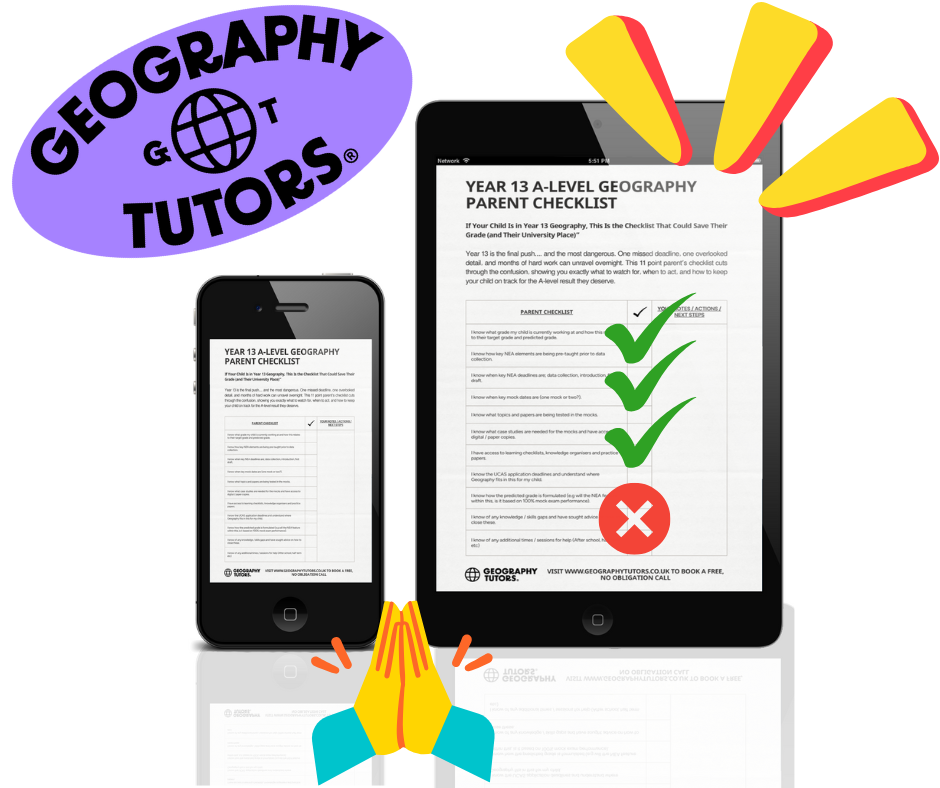
This isn’t theory. This is the distilled, boots-on-the-ground reality from working with hundreds of Year 13 Geography students. If you can’t tick off every one of these, your child’s grade (and UCAS dream) is at risk.
1. NEA (Non-Exam Assessment) Awareness
You know when key NEA deadlines are.... data collection, introduction, first draft? Do you know what elements are being pre-taught before fieldwork? If not, you’re already behind. The NEA counts for 20% of their grade.
2. Mock Exam Intel
Don’t wait for mocks to “just happen”. Find out:
Are there one or two mock series?
Which topics and papers are covered?
Which case studies are essential? The mock isn’t just practice.. it’s ammunition for predicted grades.
3. Resource Access
Your child should already have learning checklists, knowledge organisers, and practice papers for every topic. If they don’t, they’re revising blind. Demand these from the school.
4. UCAS Timing
UCAS isn’t just about hitting the January deadline. It’s about positioning your child’s application so that Geography supports, not weakens, their choices. Do you know exactly how their Geography predicted grade will impact their offer?
5. Predicted Grade Formula
Is it based solely on mocks? Does the NEA count?If you don’t know how it’s calculated, you can’t influence it. And yes — it can be influenced.
6. Knowledge & Skills Gaps
Every student has them. The danger is in not identifying and closing them early enough. You should know, right now, exactly which topics or skills are holding your child back.
7. Teaching Consistency
Not all teachers deliver the same quality of content. If your child gets clear case studies in one class and vague waffle in another, that’s a problem. Ask the school how they ensure consistency.
8. Feedback Frequency & Impact
“How often does my child get feedback?” is not the right question. The real question: Can you show me evidence where feedback has led to actual improvement?
9. Fieldwork & NEA Prep
Before they even touch the NEA, they should have had structured practice in fieldwork techniques and essay writing. No practice? Expect lower marks.
10. Extra Support Opportunities
After-school sessions, half-term revision camps, intervention clinics, these are goldmines. Do you know when and where they happen?
11. Exam Technique Training
You wouldn’t run a marathon without training. Yet many students go into A-Level exams never having truly mastered essay structure, timing, and the command verbs examiners demand.
Why This Matters More Than You Think for Year 13 Geography
A-Level Geography is a linear course — everything counts at the end. There’s no “let’s make up for it next term.” If your child falls behind now, they’re climbing the rest of the mountain with a rucksack full of rocks.
And here’s the Katharine Birbalsingh truth: schools often assume parents will just “know” this stuff. They don’t hand you the playbook.
So if you want your child to walk into that exam hall in June with the best possible shot at an A or A*, you need to become their strategist now.
The Good News
We’ve taken everything above, the must-ask questions, the key dates, the often-hidden details.. and turned it into a simple, no-fluff Year 13 Geography Parent’s Checklist.
This isn’t about micromanaging your child. It’s about making sure they’re equipped, supported, and focused on what moves the needle... not wasting hours on “busy work” revision that doesn’t deliver marks.
Year 13 Geography: Real Results from Real Students
Jack went from a C prediction in October to an A in August because his parents spotted an NEA drafting issue early... and fixed it.
Priya missed her mock target by two grades, but after strategic intervention, she secured her firm choice university offer.
Ben had strong content knowledge but poor exam technique; targeted drills turned a borderline B into an A*.
The difference wasn’t luck. It was knowledge + action.
Your Next Step
You have two options:
Hope everything works out.
Take control now.
Download the free Year 13 Geography Parent’s Checklist and get crystal clear on exactly what needs to happen and when, to secure your child’s best possible grade.
Or, if you are interested in exploring A-Level Tutoring for Geography and want a tailored plan for your child’s situation, book a free 20-minute strategy call with us.


Comments